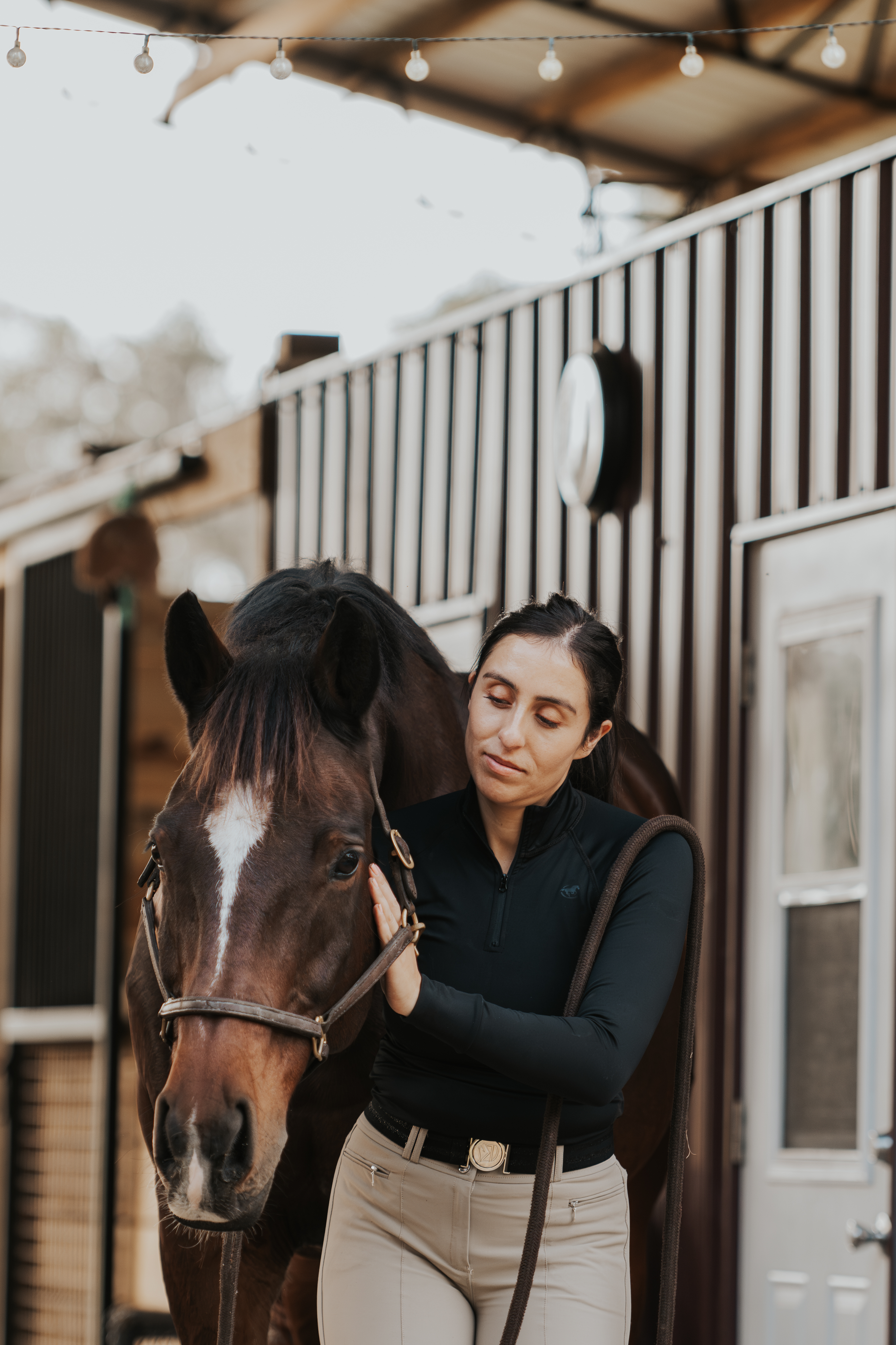
Does Massage Actually Relax horses?
Does Massage Therapy actually help relax horses?
If you have ever seen your horse spook at a plastic bag flying across the arena, you already understand something fundamental about how they are built. Horses are prey animals. Every system in their body, from their wide set eyes to their long legs to their fast (sometimes unpredictable) reflexes, evolved for one purpose which is survival.
That instinct does not turn off just because your horse lives in a safe pasture with a full hay net and a herd of friends. It is wired into their nervous system at a level far deeper than training or trust can fully override. And understanding that wiring is, in my opinion, one of the most useful things a horse owner can learn. It changes how you read your horse. It changes how you approach bodywork. And it explains why so many owners tell me their horse seems like a different animal after a massage session.
The Prey Animal Brain
In the wild, a horse's survival depends on noticing danger before it is too late. There is no room for hesitation when a predator is closing in. So horses evolved a nervous system that defaults to alertness. Their eyes are positioned to give them nearly 360 degrees of vision. Their hearing is remarkably sensitive. And their autonomic nervous system, the part of the brain and body that runs largely without conscious thought, is meant to react instantly.
This autonomic nervous system has two main branches that we need to understand.
The sympathetic nervous system is the fight or flight branch. When a horse senses a threat, whether it be a real threat or not, this system floods the body with adrenaline and cortisol. Heart rate climbs, Muscles get tense, even digestion slows. This response is fast, powerful, and each horse has different triggers. At this point, horses are so domestic that some couldn't care less about chaos around them, or their training has them so confident that they just don't worry about certain things. Then there's horses with past trauma, or a lack of experience, that flinch and worry at everything.
The parasympathetic nervous system is the opposite. This is the rest and digest branch. It slows the heart rate, supports digestion, and allows muscles to release tension that built up during a stress response. A horse who is truly relaxed, not just standing quietly but physiologically calm, is operating primarily from this parasympathetic state.
Here is the part that many owners do not realize. A horse can look calm on the outside while their body is still running on sympathetic overdrive underneath. Tight poll muscles, a locked jaw, a guarded topline, or a horse who cannot seem to settle even in a familiar environment can all be signs that the nervous system has not fully shifted out of alert mode.
Does This Matters for Bodywork?
This is where equine massage and bodywork come in, and it is also where I think a lot of the conversation around "relaxing your horse" tends to be a bit vague. Horse owners and therapists have long reported that massage helps horses relax. It's one of the main selling points of massage and on nearly every bodyworkers flyers, website, instagram, etc! This has always felt true to those of us who do this work daily. However, anecdote is not the same as evidence, and I think horse owners (and aspiring bodyworkers) deserve more than "trust me, it works."
That is why I find a small but compelling piece of research so exciting. A study presented at the 6th International Fascia Research Congress set out to actually measure whether massage therapy produces a measurable physiological shift in horses, not just a behavioral one.
Researchers Claus Peter Richter, Karen Wild, and Stephan Skiba designed a study using something most of us would never think to look at...the horse's pupil.
Pupil size is controlled by the autonomic nervous system. When the sympathetic (fight or flight) branch is active, pupils tend to dilate. When the parasympathetic (rest and digest) branch takes over, pupils tend to constrict, assuming lighting stays constant. This makes pupil size a useful window into what the nervous system is doing beneath the surface, without needing to touch the horse or attach any equipment.
In the study, one of each horse's pupils was photographed at the beginning and end of the session. Fifteen horses were split into two groups and ten received a massage. Five simply stood in the stable aisle for the same amount of time, as a comparison group. Using image analysis software, the researchers measured the ratio between the iris area and the pupil's opening, along with the ratio of the pupil's long axis to the eye's overall diameter. These measurements gave them a normalized, repeatable way to track subtle changes in pupil size.
The results were striking. In the horses who received massage, the pupil to iris area ratio decreased significantly, by an average factor of 1.39. In plain terms, their pupils shrunk much more than the 5 horses who simply stood in the aisle. The statistical analysis showed this was a real and reliable effect, not just noise in the data.
The researchers concluded that this shift reflects a relative increase in parasympathetic (rest and digest) activity and a decrease in sympathetic (fight or flight) activity following massage. In other words, the horses' nervous systems physically shifted toward that rest and digest state during and after treatment.
Why This Is a Big Deal for Horse Owners
I want to sit with this for a moment, because I think it is easy to read a study summary and move on without appreciating what it actually confirms.
For years, therapists and owners have described horses "letting go" during a massage. A deep sigh, lowered head, softened eye, licking, chewing, lower lip drooping, yawning etc. These are the visible signs many of us have learned to watch for. What this research adds is proof that these visible signs correspond to a measurable, physiological change happening inside the horse's nervous system. The pupil does not lie, and it is not influenced by training, personality, or a horse's willingness to perform calmness for their owner.
This matters because it validates something bodywork practitioners have believed all along. Massage is not just a pleasant experience for the horse. It appears to create a genuine shift away from a stress response and toward a state where the body can actually heal, digest, and restore itself. I always tell my students that massage works because of what we dp with our hands, but also how the body restores and relearns peace after a session.
You do not need a lab or an image analysis program to notice when your horse's nervous system begins to shift during bodywork. Once you know what to look for, the signs become much easier to read.
Watch for the head lowering gradually as tension releases through the poll and neck. Watch for the eye softening, sometimes described as the eye getting sleepy or half closed. Listen for a deep exhale or a full body sigh. Notice licking and chewing, which often shows up as the nervous system downshifts. Pay attention to the lower lip going loose and slightly droopy, and watch the tail. A tail that was clamped or swishing tightly often begins to hang loose and swing gently as true relaxation sets in.
These are the outward expressions of the same shift the pupillometry study measured internally. The horse is moving out of sympathetic alertness and into a parasympathetic state where actual physical restoration can happen.
The Bigger Picture
I think this research matters for a reason that goes beyond validating massage therapy. It reminds us that our horses are always carrying more than we can see on the surface. We often see our horses through a human lense, but there are underlying feelings and behaviors that we may never understand. A horse who seems fine and behaves in a stoic way, may still be holding tension deep in their bodies, simply because their nervous system has not had the chance or the safety to fully let go.
Bodywork opens the door to give the horse the chance to relax on a physiological level. It is about creating the conditions, through intentional touch, and awareness of how these prey animals are wired, for the horse's own nervous system to do what it already knows how to do.
Take my techniques into your barn through my online video library! Click here to join!
Sources
Pupillometry to show stress release during equine sports massage therapy. (2023).Journal of Bodywork & Movement Therapies,33, e106. https://doi.org/10.1016/j.jbmt.2022.12.085